More Than Half the Web's Traffic Is Now Machines. Can They Actually Read Your Site?
Most marketers still use AI the manual way: open a chat window, type a prompt, paste the answer elsewhere, repeat. It helps, but it caps out fast — one person, one conversation, endless copy-paste between tools.

More Than Half the Web’s Traffic Is Now Machines. Can They Actually Read Your Site?
*AI agents are quickly becoming the primary readers — and buyers — on the internet. Most websites are still built only for humans. Here’s what “agent-ready” really means, why the new readiness scores are only a starting line, and how to turn legibility into revenue.*
On June 3, 2026, Cloudflare’s CEO noted a milestone that the rest of the industry had been bracing for: automated traffic had overtaken human traffic on the web for the first time. Cloudflare’s own Radar data, drawn from roughly a fifth of all websites, put machines at around 57.5% of HTML traffic and people at 42.5%. The notable part wasn’t the crossover itself — it was the timing. At SXSW just months earlier, the same prediction had been pegged to the end of 2027. It arrived roughly eighteen months early.
This isn’t the old story of crawlers and scrapers. The traffic that flipped the balance is a new category: AI agents acting on behalf of real people — reading pages, comparing options, filling in forms, and completing tasks. One report from HUMAN Security clocked agentic traffic growing on the order of 7,000%-plus year over year, expanding several times faster than human activity.
The reason the share tipped while human usage didn’t fall is asymmetry. When a person shops for running shoes, they might check five sites. When an agent runs the same errand, it can visit hundreds. A single human intention now produces an explosion of machine reads. Your real audience just changed shape — and the uncomfortable truth is that most websites can’t be read by the software now driving discovery and purchase.
A third reader has arrived
The web has rewritten itself before. First it learned to speak to browsers, and HTML and CSS became the price of entry. Then it learned to speak to search crawlers, and sitemaps, structured data, and SEO became the difference between being found and being invisible. Each shift quietly rewarded the sites that learned the new visitor’s language first.
A third reader is here now. The agent doesn’t browse the way a person does, and it doesn’t index the way a crawler does. It reads, reasons, and acts — usually in seconds, and often to make a decision or complete a transaction for someone else. That changes the standard. “Looks great to a human” and “ranks on Google” are no longer the same thing as “an agent can use you.” A site can be beautiful, fast for people, and perfectly optimized for search, and still be functionally invisible to the layer of software that increasingly sits between your brand and your next customer.
What an agent actually experiences on your site
An agent doesn’t care about your hero animation or your scroll-triggered transitions. It wants the facts — cleanly, in a format it can parse without spinning up a full browser.
The gap between what your site shows a human and what an agent can actually extract is measurable, and it’s wide. Adobe scored the average U.S. product page at roughly 66% machine-readable. Read that the other way: about a third of the content on the exact page where someone decides to buy is opaque to an agent. And what an agent can’t parse, it won’t recommend. Agents do not guess in your favor.
The usual culprits are familiar to anyone who has shipped a modern site: content that only appears after heavy JavaScript renders, critical facts like price, availability, specs, and return policies trapped inside images or unlabeled markup, no structured data, and no machine-readable summary of what a page even is.
There’s a cost dimension, too, and it cuts in your favor when you get it right. When Cloudflare rebuilt its own developer documentation to be agent-legible — serving clean markdown and tightening structure — it measured around 31% fewer tokens consumed and roughly 66% faster correct answers from an AI assistant working the same questions. Illegibility is slow and expensive for the agent. Legibility earns the agent’s attention, and its trust.
The agent-readiness stack
Strip away the acronyms and an agent needs four things from your site. Each maps to real, increasingly standardized infrastructure.
**1. Discovery — can it find and map you without scraping blind?** This is the agent equivalent of “can a search crawler reach you at all.” It means a `robots.txt` (RFC 9309) that makes deliberate choices about AI bots, an accurate sitemap, and HTTP `Link` headers (RFC 8288) that point agents straight to your metadata and machine-readable resources instead of forcing them to parse your HTML to figure out what you are.
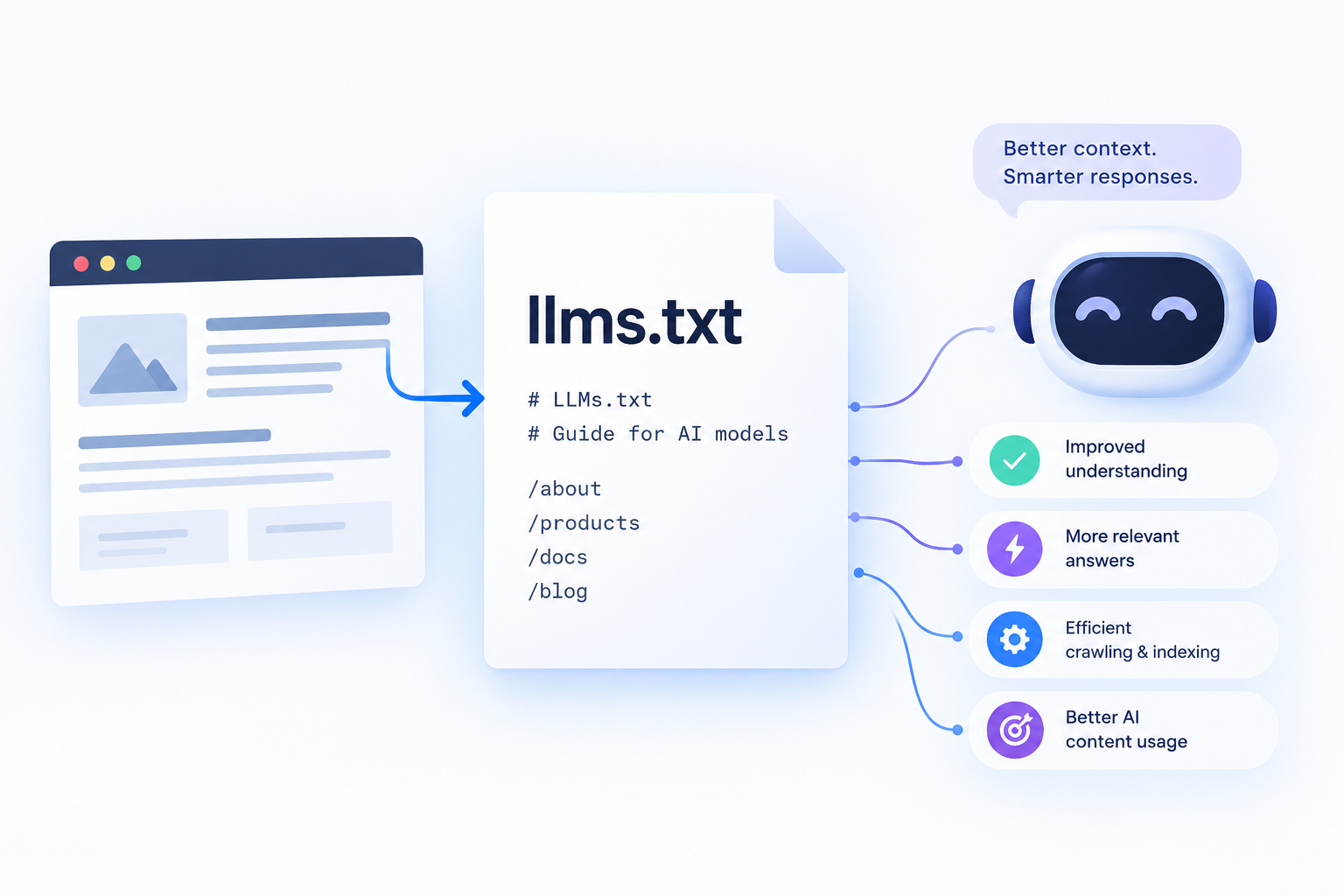
**2. Legibility — can it read what it finds, cheaply?** Clean semantic HTML, `schema.org` structured data on the things that matter (products, prices, FAQs, your organization), and content negotiation that serves a markdown version of a page when an agent asks for one with `Accept: text/markdown`. There’s also a proposed `llms.txt` convention for handing models a curated map of your content. It’s worth knowing and cheap to ship — but be clear-eyed about it. It isn’t a ratified standard, the competing proposals haven’t settled, and in May 2026 Google stated plainly that you don’t need `llms.txt` or AI-specific markup for its generative results. Treat it as a low-cost bet, not a silver bullet.
**3. Access control — who gets what, on whose terms?** Agents reading your site is not all-or-nothing. Emerging signals such as Content Signals, and agent authentication via cryptographically signed requests, let you welcome the agents that drive value while setting terms for the rest. The mistake is the blanket block — more on that shortly.
**4. Action — can it actually do something?** For SaaS and commerce, reading isn’t enough; the agent needs to complete a task. That’s the protocol layer: MCP and the newer WebMCP, which lets a site expose real tools — functions and forms — to browser-based agents; OAuth discovery so an agent can authenticate; and the agentic-commerce standards (OpenAI and Stripe’s ACP, Google’s UCP, payment rails like x402) that move an agent from “found your product” to “bought it.”
The score is a floor, not the finish line
In April 2026, Cloudflare shipped the first public scoreboard for all of this: an Agent Readiness Score, available at isitagentready.com, that grades any URL from 0 to 100 across roughly sixteen checks in five categories. When Cloudflare ran the numbers across 200,000 of the top sites on the web, the verdict on whether the internet is ready for agents was a flat no.
Use the score — but read it correctly. The headline composite runs every check, including API and commerce protocols that don’t apply to a content site, so a perfectly healthy marketing site can land in the low 30s on the default preset and jump to the high 60s once you scope it to the right site type. The composite number is a shareable marketing artifact. The per-category results are the actual diagnostic.
And here’s the part no score can tell you: passing it is table stakes. Compliance is a checkbox every competitor in your category can tick. Most of these standards are uncontroversial, which means that once everyone implements them, “agent-ready” stops being a differentiator and becomes a baseline.
The durable advantage sits one layer up — in whether an agent actually *chooses* you. Being readable gets you into the consideration set. Being the answer an agent recommends, cites, and buys from is a different discipline entirely: clear, trustworthy, well-structured information that AI engines prefer, measured by which queries you win and lose over time. This is Answer Engine Optimization, and it is where readiness converts into revenue.
It matters because the agents are already spending. Adobe found AI-referred traffic to U.S. retailers up around 393% year over year in early 2026 — but the bigger story is what that traffic does once it lands. After converting *worse* than other channels a year earlier, AI-referred shoppers were converting roughly 42% *better* by spring 2026, a record in Adobe’s data, while spending longer on site and generating more revenue per visit. Shopify reported AI-driven traffic up roughly 8x with orders up around 13x. The shopper arriving from an AI conversation has already compared options and shown up ready to buy. The only question is whether your catalog was legible enough to be in that conversation in the first place.
The expensive way to get this wrong
There are two failure modes, and they pull in opposite directions.
The first is illegibility — being unreadable, and therefore quietly absent from the agent-mediated decisions being made about your category every single day. For most businesses, this is the real and present risk.
The second is hostility, done carelessly. Amazon blocks the major AI shopping crawlers in its `robots.txt`, which makes its catalog ineligible to surface in real-time ChatGPT shopping results — and in March 2026 a U.S. federal court issued a preliminary injunction stopping Perplexity’s agent from completing purchases on Amazon, after Amazon argued the agent disguised automated sessions as human traffic. The lesson isn’t “block everything” or “allow everything.” It’s that access has become a deliberate strategic choice, and the lawful, durable path is protocol-led and opt-in — neither a wall nor a free-for-all. Most companies aren’t Amazon, and for them, walling off the fastest-growing discovery channel on the internet is the more expensive mistake.
Where to start
You don’t need to boil the ocean. You need to move in the right order.
1. **See yourself as an agent sees you.** Run your URL through Cloudflare’s scanner using the correct site-type preset, and read the per-category results — not just the headline number.
2. **Fix discovery first.** Make `robots.txt` a deliberate policy, ship an accurate sitemap, and add RFC 8288 `Link` headers that point agents to your metadata.
3. **Make your money pages legible.** Get price, availability, specs, and policies into clean HTML and `schema.org` structured data — not buried in images or rendered only after JavaScript. If your most important facts need a browser to appear, assume agents won’t see them.
4. **Serve machine-friendly content.** Offer a clean `text/markdown` variant where it’s cheap to do so. It lowers the cost of reading you and, as Cloudflare’s own data shows, can sharply improve both speed and accuracy.
5. **Decide your agent policy on purpose.** Welcome the agents that create value and set terms for the rest. Don’t reflexively block your way out of a channel that’s compounding by the month.
6. **Then optimize for the answer, not just the crawl.** Readiness gets you parsed; AEO gets you chosen. Track which AI queries surface your brand, and treat it as an ongoing program rather than a one-time fix.
The plumbing is connected. Now do the work.
The web learned to speak to browsers, then to search engines, and the sites that moved early each time spent the next decade ahead of the ones that waited. The agentic shift is the same pattern — arriving faster than almost anyone forecast, including the company that measures it.
Agent-readiness isn’t a compliance task to file away. It’s the new baseline for being discoverable and the foundation for being chosen. A good score tells you the plumbing is connected. Whether it turns into customers is the part that’s still up to you.
—
At Matrixe Zone, this is the work we do: making brands legible to AI agents and, more importantly, the answer those agents recommend. We start most engagements with a diagnostic audit — where your site stands today, exactly what an agent can and can’t read, and a prioritized set of fixes that move you from *parsed* to *preferred*. Outcomes, not output.
**Want to know how an AI agent sees your site?** [Get your AI visibility audit →]